
Key Takeaways
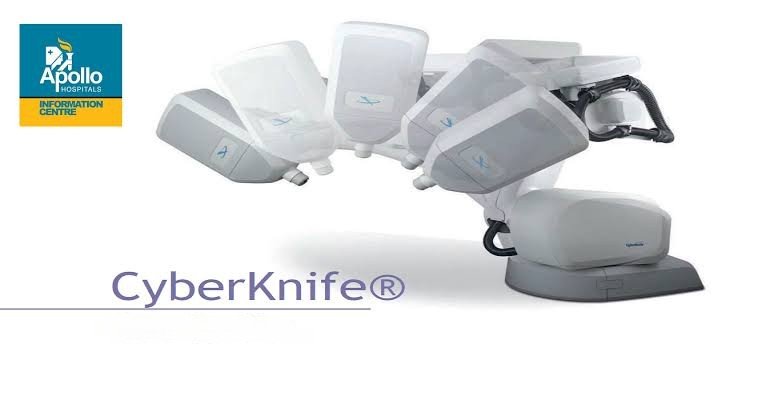
CyberKnife® is a non-invasive form of stereotactic radiosurgery used to treat certain brain tumors and related conditions with sub-millimeter precision, without incisions or general anaesthesia. Apollo Hospitals in India offers CyberKnife treatment, including South Asia’s first CyberKnife® S7™ FIM system at Apollo Cancer Centre, UAE-based patients can explore this treatment pathway through Apollo Clinic ,Karama, Dubai, UAE.
- CyberKnife delivers high-dose radiation from thousands of angles while sparing healthy surrounding tissue.
- Treatment is typically completed in 1 to 5 outpatient sessions, compared to weeks of daily sessions for conventional radiotherapy.
- It can treat benign tumors, malignant tumors, brain metastases, and certain functional disorders such as trigeminal neuralgia.
- It is not suitable for every case — suitability depends on tumor type, size, and location, and is determined by a radiation oncologist.
- Apollo Hospitals in India, and has been a pioneer in offering advanced cancer treatments, including CyberKnife. provide CyberKnife treatment programs.
- UAE-based patients can begin the process with an initial consultation and records review at Apollo Clinic UAE before travelling for treatment.

Understanding CyberKnife Technology
CyberKnife® is an advanced form of stereotactic radiosurgery (SRS) that uses robotics, real-time imaging, and treatment-planning software to deliver precise, high-dose radiation directly to a tumor. Unlike conventional surgery, CyberKnife does not involve incisions or general anaesthesia. A robotic arm delivers radiation from thousands of angles, targeting the tumor accurately while sparing surrounding healthy tissue.
The CyberKnife® S7™ FIM system is among the most advanced versions of this technology. It uses real-time motion synchronization to adapt to small movements of the patient or tumor, such as those caused by breathing, which helps maintain accuracy and reduce radiation exposure to nearby healthy structures.
How CyberKnife Treatment Works
CyberKnife treatment generally follows four stages, from initial evaluation through to follow-up care.
1. Initial Consultation and Planning
Treatment begins with a consultation involving a radiation oncologist and a multidisciplinary care team. Advanced imaging such as MRI or CT scans is used to map the tumor and the surrounding anatomy.
2. Customized Treatment Planning
Treatment-planning software is used to design a personalized plan, calculating the optimal angles and intensity of the radiation beams for that specific tumor. In some cases, small fiducial markers may be implanted beforehand to improve targeting precision.
3. Outpatient Treatment Sessions
Each session typically lasts 15 to 45 minutes, though duration can vary depending on the tumor being treated. Patients remain comfortable and breathe normally while the robotic arm moves around them to deliver radiation. The procedure itself is pain-free and does not require recovery downtime.
4. Post-Treatment Follow-Up
Most patients experience minimal side effects and can resume daily activities almost immediately. Follow-up visits and imaging are scheduled to assess how well the treatment has worked and to address any concerns.
Benefits of CyberKnife Radiotherapy
· Non-Invasive and Painless: CyberKnife eliminates the need for surgical incisions, reducing the risks associated with infection and anaesthesia.
· Exceptional Precision: The system delivers radiation with sub-millimeter accuracy, minimizing damage to healthy tissue and critical brain structures.
· Shorter Treatment Duration: Unlike conventional radiotherapy, which may require weeks of daily sessions, CyberKnife treatment is typically completed in 1 to 5 sessions.
· Minimal Recovery Time: Patients can return to their normal routines almost immediately, making it a practical option for those wanting minimal disruption to daily life.
· Reduced Risk of Recurrence: Precise targeting and high-dose delivery support long-term tumor control, which may lower the likelihood of recurrence in suitable cases.
Conditions CyberKnife Can Treat
CyberKnife is used for a range of brain tumors and related conditions, including:
· Benign tumors: Acoustic neuromas, meningiomas, and pituitary adenomas
· Malignant tumors: Brain metastases and gliomas
· Functional disorders: Trigeminal neuralgia and Parkinson’s-related tremors
Suitability for CyberKnife depends on the specific tumor type, size, and location, and is assessed individually by a radiation oncologist.
Comparing CyberKnife to Traditional Treatment Approaches
Surgery remains a standard treatment for many brain tumors, but it may not be suitable for inoperable or deep-seated tumors. Conventional radiotherapy is effective but often requires multiple sessions over several weeks and carries a higher risk of affecting healthy tissue nearby. CyberKnife offers a non-invasive, highly targeted alternative for appropriate cases, with fewer sessions and generally fewer side effects.
| Factor | Surgery | Conventional Radiotherapy | CyberKnife |
| Invasiveness | Requires incision and anaesthesia | Non-invasive | Non-invasive |
| Typical sessions | Single procedure | Multiple sessions over weeks | 1 to 5 sessions |
| Recovery time | Days to weeks | Cumulative fatigue over course | Minimal, often immediate |
| Best suited for | Accessible, operable tumors | Larger treatment areas | Well-defined, precisely located tumors |
Real-Life Impact
Consider a patient diagnosed with a recurrent meningioma located near the brainstem. Traditional surgery posed significant risks because of the tumor’s location. Choosing CyberKnife instead, the patient underwent three painless sessions. Post-treatment imaging showed effective tumor shrinkage, and the patient resumed daily activities with no neurological deficits. Individual outcomes vary, and any case should be assessed by a treating oncology team.
CyberKnife Treatment at Apollo Hospitals, India
Apollo Hospitals is one of India’s largest healthcare groups and offers CyberKnife treatment programs at several of its centres. Apollo Cancer Centre, Teynampet, Chennai, houses South Asia’s first CyberKnife® S7™ FIM Robotic Radiosurgery System, supported by a multidisciplinary oncology team of radiation oncologists and medical physicists.
Care typically follows the same structured pathway described above: an initial multidisciplinary consultation, imaging-based treatment planning, outpatient treatment sessions, and scheduled follow-up to assess response.
How UAE-Based Patients Can Access CyberKnife Treatment via Apollo Clinic UAE
For patients based in the UAE, exploring advanced treatment options such as CyberKnife often means coordinating between a local point of contact and the treating hospital in India. Apollo Clinic UAE can support this process for patients considering treatment at Apollo Hospitals, India.
A typical medical-travel pathway generally includes the following steps:
1. Initial consultation at Apollo Clinic UAE to discuss the diagnosis and share existing medical records and imaging.
2. Review of records by the treating oncology team in India to assess suitability for CyberKnife treatment.
3. A treatment recommendation and cost estimate shared with the patient before travel is arranged.
4. Coordination of travel, appointment scheduling, and any visa or logistics support needed for the visit to India.
5. Treatment delivered at the Apollo facility in India, followed by post-treatment imaging and review.
6. Ongoing follow-up coordinated between the treating team in India and Apollo Clinic UAE where possible.
Conclusion
CyberKnife radiotherapy offers a non-invasive, highly targeted option for treating certain brain tumors, combining precision, comfort, and shorter treatment timelines compared to conventional approaches. For UAE-based patients, Apollo Clinic UAE can serve as a starting point for exploring whether CyberKnife treatment at Apollo Hospitals, India, may be appropriate. If you or a loved one is facing a brain tumor diagnosis, the most important first step is a consultation with a qualified oncology team to review the specific case and discuss suitable treatment options.
Frequently Asked Questions
Is CyberKnife the same as surgery?
No. CyberKnife is a non-surgical radiosurgery technique. It does not involve incisions or general anaesthesia; instead, it delivers precisely targeted radiation to the tumor from outside the body.
How many CyberKnife sessions are usually needed?
Most patients require between 1 and 5 outpatient sessions, compared to several weeks of daily treatment with conventional radiotherapy. The exact number depends on the tumor’s size, type, and location.
Is CyberKnife painful or does it require recovery time?
The procedure itself is pain-free, and most patients can resume normal activities almost immediately afterward, since there is no surgical wound to heal.
Can every brain tumor be treated with CyberKnife?
No. Suitability depends on the tumor’s type, size, and location. A radiation oncologist evaluates each case individually to determine whether CyberKnife or another treatment approach is more appropriate.
Where is CyberKnife available at Apollo Hospitals in India?
Apollo Cancer Centre, Teynampet, Chennai, houses South Asia’s first CyberKnife® S7™ FIM system. [INSERT: confirm current list of Apollo locations offering CyberKnife before publishing.]
How can a UAE-based patient start the process of getting CyberKnife treatment in India?
Patients can begin with a consultation at Apollo Clinic UAE to review their diagnosis and share medical records. These are then assessed by the treating oncology team in India, who advise on suitability, next steps, and how to plan the visit.
Medical Disclaimer
This article is intended for general information only and does not replace professional medical advice, diagnosis, or treatment. Suitability for CyberKnife treatment varies by individual case and can only be determined by a qualified oncology team after reviewing full medical records and imaging. Please consult a doctor to discuss options specific to your diagnosis.

