
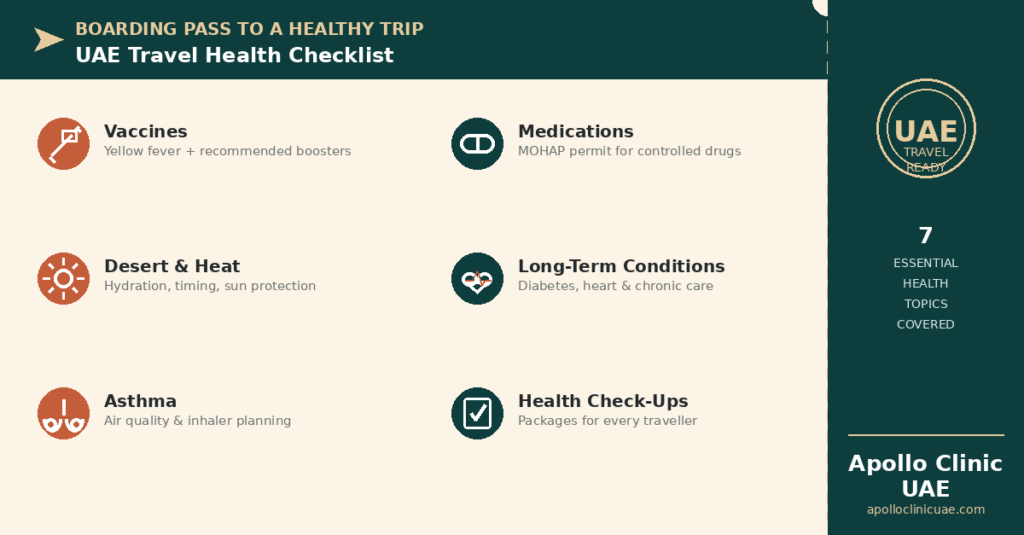
Key Takeaways
Planning a trip to the UAE takes more than checking the weather. Getting your vaccines and travel medications sorted, understanding the UAE’s strict rules on bringing medicines into the country, and preparing for heat, desert activities, and any long-term health conditions can make the difference between a smooth trip and a stressful one.
· Only yellow fever vaccination is legally required, and only for travellers arriving from at-risk countries; hepatitis A, typhoid, and routine boosters are commonly recommended.
· The UAE enforces strict controlled-medicine laws — common medications like codeine, tramadol, and some sleeping or anxiety medications require a permit or documentation.
· Book a pre-travel health consultation 4 to 6 weeks before departure to allow time for vaccines and any required permits.
· UAE summers regularly exceed 45°C, so heat-related illness is a real risk for desert trips and outdoor activities.
· Travellers with diabetes, asthma, or other long-term conditions should carry a doctor’s letter and plan medication storage around the heat.
· Apollo Clinic UAE offers pre-travel consultations, vaccinations, and health check-up packages for residents and visitors.
What Vaccines and Medications Do I Need for the United Arab Emirates?
The UAE has only one legal vaccine requirement, and it applies to a specific group of travellers: proof of yellow fever vaccination is required for anyone aged 9 months or older arriving from, or who has transited more than 12 hours through, a country with risk of yellow fever transmission. The UAE itself has no yellow fever risk, but the certificate requirement is still enforced at entry.
Beyond that legal requirement, several vaccines are commonly recommended for travellers, depending on age, length of stay, and planned activities:
· Hepatitis A: Especially important if eating and drinking outside well-established restaurants and hotels.
· Hepatitis B: Recommended for longer stays, residents, and anyone who may need medical or dental treatment locally.
· Typhoid: Advisable if travelling outside major cities or eating street food.
· Tetanus, diphtheria, pertussis (Tdap) and MMR: Confirm these are up to date, since many travellers overlook routine boosters before international travel.
· Rabies: Worth considering for anyone likely to spend extended time outdoors, hiking, or handling animals.
Vaccine needs vary by individual health history, itinerary, and how recently routine vaccinations were updated. A pre-travel consultation is the most reliable way to confirm which of these apply to your specific trip.
What Health Precautions Should I Take in the UAE?
The UAE has excellent healthcare infrastructure and generally high standards of food and water safety in cities, particularly in hotels and established restaurants. Most health risks for travellers relate to environment and heat rather than infectious disease.
· Heat and sun exposure: The UAE’s climate is hot and dry for most of the year, and summer temperatures regularly exceed 45°C (113°F). Carry water at all times and avoid strenuous activity during peak afternoon heat.
· Food and water: Tap water in major cities is generally treated and safe, though many residents and visitors prefer bottled or filtered water for taste. Exercise normal caution with food from informal vendors.
· Air quality: Air quality can dip during sandstorms or high humidity periods, which is worth factoring in for anyone with asthma or other respiratory conditions.
· Local laws: The UAE has a zero-tolerance policy for illegal drugs and strict laws on alcohol consumption outside licensed venues; familiarize yourself with local regulations before travelling.
How Do I Pick Up My Travel Medications and Align With UAE Law?
This is one of the most important questions for anyone travelling to the UAE with regular prescription medication, and it is also one of the most commonly overlooked. The UAE classifies a wide range of everyday medications — including codeine, tramadol, and several medicines for anxiety, insomnia, and ADHD — as controlled or semi-controlled substances under Federal Decree-Law No. 30 of 2021 on Combating Narcotics and Psychotropic Substances. Carrying these without the correct documentation can lead to serious legal consequences, including detention.
Steps to bring prescription medication into the UAE legally
1. Ask your doctor whether your medication is classified as controlled or semi-controlled in the UAE — many common painkillers and sedatives are.
2. For controlled or semi-controlled medicines, apply for a free import permit through the UAE Ministry of Health and Prevention (MOHAP) before you travel, via their online portal.
3. Carry the original prescription, showing the patient’s full name, medicine name, dose, dosage form, and treatment duration, issued within the last few months.
4. If you were not able to obtain a permit in advance, declare your medication at the port of entry along with your prescription and any medical report.
5. Keep quantities within the permitted limits — generally up to three months’ supply for controlled medicines and longer for non-controlled medicines — matching what your prescription supports.
6. Keep medication in its original, labelled packaging rather than loose in a pill organizer.
These rules apply to both visitors and residents, and enforcement is taken seriously. If in doubt about a specific medication, it is worth confirming with your prescribing doctor or the MOHAP portal before you pack.
Common Medication Categories and UAE Import Status
|
Medication Type |
UAE Classification |
What This Means for Travellers |
|
Codeine, tramadol, and combination painkillers containing them |
Controlled |
Requires a MOHAP import permit or declaration with prescription on arrival |
|
Diazepam, alprazolam, clonazepam and similar |
Controlled (psychotropic) |
Requires a MOHAP import permit or declaration with prescription on arrival |
|
ADHD medications (amphetamine-based) |
Controlled |
Requires a MOHAP import permit or declaration with prescription on arrival |
|
Most other prescription medicines (e.g. blood pressure, diabetes, asthma medication) |
Non-controlled |
Carry original prescription; permit generally not required for personal-use quantities |
|
Cannabis and related products |
Prohibited |
Cannot be imported under any circumstances, medical use elsewhere notwithstanding |
Desert Trips and Outdoor Activities
Desert safaris, dune drives, and camel treks are among the most popular activities for visitors to the UAE, but the desert environment carries real risks that are easy to underestimate, particularly for travellers unused to extreme heat.
· Hydration: Dehydration can develop quickly in dry desert heat, even when you don’t feel thirsty. Drink water regularly rather than waiting until you feel dehydrated.
· Timing: Early morning or evening desert excursions are considerably safer than midday activities, when ground temperatures can be extreme.
· Sun protection: Loose, breathable, light-coloured clothing, a wide-brimmed hat, and high-SPF sunscreen reduce heat and sun exposure significantly.
· Heat illness awareness: Know the signs of heat exhaustion — heavy sweating, dizziness, nausea, and headache — and move to shade and cool down immediately if they appear. Heatstroke, marked by confusion or a stop in sweating, is a medical emergency.
· Reputable operators: Only join desert excursions with licensed, reputable tour operators, and let someone know your planned route and return time.
Travelling With Diabetes or Other Long-Term Conditions
Managing a chronic condition while travelling adds planning steps, and the UAE’s heat and medication regulations make this particularly relevant. A little extra preparation goes a long way.
· Carry a doctor’s letter: A letter from your doctor describing your condition, current medications, and any devices you carry (such as insulin pens or pumps) is useful both for airport security and in case you need local medical care.
· Plan for heat-sensitive storage: Insulin and some other medications require refrigeration or protection from heat. Use an insulated travel case, particularly for desert excursions or long days outdoors.
· Bring extra supplies: Pack more than your trip requires, split across your carry-on and checked luggage in case one bag is delayed.
· Check medication classification: If your condition requires controlled medication (such as certain pain or anxiety management drugs), follow the same MOHAP permit process described above.
· Know where to get help locally: Note the location of pharmacies and hospitals near where you’re staying, and keep a copy of your prescription accessible at all times.
Asthma and Breathing Conditions
The UAE’s climate presents a mixed picture for travellers with asthma or other respiratory conditions. Air conditioning is widespread indoors, which helps manage heat, but the contrast between very hot outdoor air and cold indoor air can be a trigger for some people. Dust and sand in the air, particularly during sandstorms or in desert areas, can also aggravate symptoms.
· Pack sufficient medication: Bring more inhalers and medication than you expect to need, in their original packaging with your prescription.
· Manage temperature transitions: Some travellers find sudden shifts between hot outdoor air and strongly air-conditioned interiors uncomfortable; carrying a light layer can help.
· Monitor air quality: On high-dust or sandstorm days, consider limiting time outdoors and keeping rescue medication easily accessible.
· Plan with your doctor: Discuss your travel plans and any activity changes, such as desert excursions, with your doctor before you go.
Find a Medical Health Check-Up Package for Every Need
Whether you’re preparing for travel, settling in as a new resident, or simply due for a routine review, a structured health check-up is one of the most efficient ways to catch potential issues early and get personalized advice for your specific circumstances.
· Pre-Travel Health Check: [INSERT: package name, inclusions — e.g. vaccination review, basic bloodwork, doctor consultation]
· General Wellness Check-Up: [INSERT: package name, inclusions — e.g. full blood panel, ECG, physical examination]
· Diabetes and Metabolic Screening: [INSERT: package name, inclusions — e.g. HbA1c, lipid profile, kidney function tests]
· Respiratory and Allergy Assessment: [INSERT: package name, inclusions — e.g. lung function test, allergy panel]
· UAE Residency Medical Fitness Test: [INSERT: package name, inclusions — e.g. required tests, medical fitness certificate]
[INSERT: link to full list of health check-up packages and pricing on apolloclinicuae.com]
Conclusion
A little preparation before travelling to the UAE goes a long way — confirming which vaccines make sense for your trip, understanding which medications need a permit, and planning around the heat if you have a long-term condition or plan to spend time outdoors. For anything specific to your health history or medication list, a pre-travel consultation is the most reliable way to travel with confidence.
Frequently Asked Questions
Do I need a visa-related vaccine to enter the UAE?
No vaccine is required for UAE entry unless you are arriving from, or have transited more than 12 hours through, a country with risk of yellow fever transmission, in which case a yellow fever certificate is required.
Can I bring my regular prescription medication to the UAE?
Most non-controlled medications can be carried with your original prescription. Certain medicines — including codeine, tramadol, some anxiety and sleep medications, and ADHD medications — are classified as controlled and require a MOHAP import permit or declaration on arrival.
What happens if I don’t get a medicine import permit in advance?
If you haven’t obtained prior approval, you must declare your controlled medicines at the port of entry along with your prescription and any relevant medical report. It’s simpler and lower-risk to apply for the free permit before travelling.
Is it safe to drink tap water in the UAE?
Tap water in major UAE cities is generally treated and considered safe, though many people prefer bottled or filtered water by preference rather than necessity.
What’s the biggest health risk on a desert safari?
Heat-related illness, including dehydration and heat exhaustion, is the most common risk. Staying hydrated, avoiding peak midday heat, and recognizing early symptoms are the most effective precautions.
How far in advance should I book a pre-travel health check?
Ideally 1 to 2 days before visiting Apollo clinic.
Medical and Travel Disclaimer
This article is intended for general information only and does not replace professional medical or legal advice. Vaccine recommendations, medication regulations, and entry requirements can change; please confirm current requirements with a healthcare professional and official UAE government sources (such as MOHAP) before travelling.

