
Key Takeaways
Liver disease is often manageable in its early stages through medical treatment and lifestyle changes, but advanced cases may require specialised surgery or a liver transplant. Apollo Hospitals, India, offers one of the region’s most established liver care programs, spanning medical hepatology, hepatobiliary and pancreatic surgery, and liver transplantation, with UAE-based patients able to begin the process through Apollo Clinic Dubai.
· Treatment for liver disease ranges from diet and lifestyle changes in early-stage disease to liver resection, hepatobiliary surgery, or transplantation in advanced cases.
· Chronic liver injury can progress to cirrhosis (scarring), which increases the risk of liver failure and liver cancer.
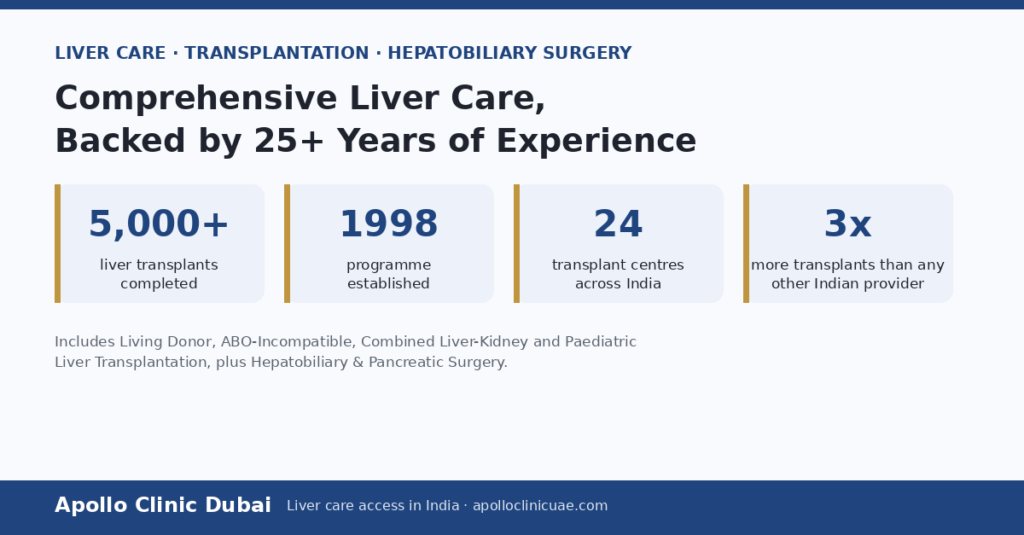
· The Apollo Liver Transplant Program has completed over 5,000 liver transplants since 1998 — the first programme in India and South Asia to reach this milestone.
· Apollo performs advanced techniques including living donor liver transplantation, ABO-incompatible transplants, combined liver-kidney transplants, and pediatric liver transplants in infants as young as 4 months.
· Hepatobiliary and pancreatic surgery at Apollo covers liver resection, gallbladder and bile duct surgery, and pancreatic surgery, often using minimally invasive and robotic techniques.
· UAE-based patients can start with a consultation and records review at Apollo Clinic Dubai before travelling to India for specialist liver care.

A Comprehensive Treatment Plan for All Stages of Liver Disease
Liver disease is not a single condition but a spectrum, ranging from early, reversible changes to advanced, life-threatening liver failure. The right treatment depends heavily on which stage a patient is at, which is why a comprehensive program — rather than a single treatment pathway — matters. Apollo’s approach spans medical management, minimally invasive procedures, surgery, and transplantation, with the treatment plan built around the specific stage and type of disease rather than a one-size-fits-all protocol.
How Liver Disease Progresses
Long-term, repeated injury to the liver — from causes such as viral hepatitis, alcohol use, or fatty liver disease — can lead to chronic liver disease. Over time, this often results in cirrhosis, or scarring of the liver tissue. Cirrhosis can eventually cause the liver to lose function, producing symptoms such as jaundice, easy bleeding or bruising, and fluid build-up in the abdomen (ascites). Liver cancer is also more common in a cirrhotic liver, particularly where cirrhosis is linked to viral hepatitis or fatty liver disease.
Matching Treatment to the Stage of Disease
For earlier-stage conditions such as fatty liver disease, initial management typically focuses on lifestyle changes, monitoring, and treating any underlying cause. A liver biopsy may be used to assess how advanced the disease has become. As liver disease progresses, treatment may extend to management of complications, endoscopic procedures such as ERCP for bile duct or pancreatic duct problems, and surgical options including liver resection for tumors. In the most advanced cases — particularly decompensated cirrhosis or acute liver failure — liver transplantation may become the only effective option.
Because these stages call for very different expertise, Apollo’s liver program brings hepatologists, hepatobiliary surgeons, transplant surgeons, interventional radiologists, and critical care specialists together under one multidisciplinary team, so that a patient’s treatment plan can shift as their condition changes without starting over with a new team.
Liver Disease and the Need for Transplantation
Not every patient with liver disease will need a transplant, but for certain conditions, it becomes the only treatment capable of restoring health once the liver’s function has declined beyond what medical treatment can manage.
When Transplantation Becomes Necessary
Transplantation is generally considered when chronic liver disease reaches an advanced, decompensated stage — meaning the liver can no longer perform its essential functions despite treatment — or in cases of acute (fulminant) liver failure, where the liver fails rapidly, sometimes over days. In acute cases, some patients recover with intensive medical treatment alone, but those who do not respond may need urgent living donor or deceased donor liver transplantation to survive. Liver transplantation may also be considered for certain liver cancers that meet specific clinical criteria, and for some inherited or metabolic liver conditions.
Emergency and Urgent Transplant Capability
Acute liver failure can progress quickly, which is why having emergency transplant capability matters. Apollo Hospitals is recognised as a referral centre for hepatobiliary and pancreatic disorders and liver trauma, with a dedicated liver intensive care unit supporting patients through both medical stabilization and, where necessary, emergency transplantation. This includes access to liver support therapies used to stabilize patients with acute liver failure while a suitable donor organ is identified.
Special Techniques for Liver Transplantation
Liver transplantation has advanced considerably beyond standard deceased-donor transplants. Apollo’s program performs a range of advanced techniques that expand who can receive a transplant and how quickly it can happen.
· Split Liver Transplantation: Here a Cadaveric liver is divided into two parts and can then be used for transplanting two patients in need of liver transplant.
· Auxillary Liver Transplantation: This is a special type of liver transplantation where only a part of the patient’s liver is removed and a partial liver graft is implanted. This operation is especially useful in some patients with acute liver failure where the liver is expected to recover over a period of time.
Swap Liver Transplantation: Swap Liver transplantation is performed when there is no donor whose blood type is performed when there is no donor whose blood type is compatible with the patient. Those whose blood type is incompatible but wish to donate their liver to relatives may apply to transplantation center to be prepared for swap transplant.
·Domino Liver Transplantation: This is when a patient who has undergone a liver transplantation donates his/her liver to another recipient.
Monosegmental Liver Transplantation: The shortage of organ donors for low weight liver transplant recipients, especially small children, has led to the development of new surgical techniques to increase the donor pool. A liver transplant for infant brings with it an array of complications, due to the small size of the infant’s abdomen cavity in order to overcome this complexity, an innovative technique called monosegmental liver transplantation has benn developed and put into place.
Apollo’s Liver Transplant Program Track Record
As of October 2025, the Apollo Liver Transplant Program had completed over 5,000 liver transplants since the program began in November 1998, including more than 4,300 adult and over 600 pediatric procedures, along with 700 deceased donor transplants and 73 combined liver-kidney transplants. This makes it the first liver transplant program in India and South Asia to reach that milestone, and it is the only liver transplant program in India to have been honoured with a commemorative postal stamp by the Government of India.
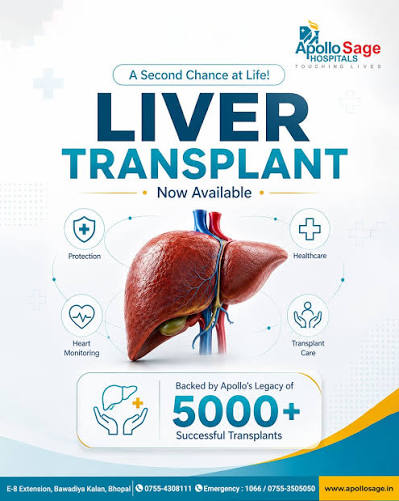
Apollo Liver Transplant Program: Track Record at a Glance
| Metric | Figure (as of October 2025) |
| Total liver transplants completed | 5,001, since November 1998 |
| Adult liver transplants | 4,391 |
| Pediatric liver transplants | 611, including infants from 4 months / 3.5 kg |
| Deceased donor transplants | 700 |
| Combined liver-kidney transplants | 73 |
| Recognition | First programme in India/South Asia to reach 5,000 transplants; the only liver transplant programme honoured with a Government of India commemorative postal stamp |
A Multidisciplinary Transplant Team
A liver transplant involves far more than a single surgeon. Apollo’s transplant program brings together a transplant surgeon, transplant physician, dedicated anaesthetists and intensivists, radiologists, specialised nursing and pharmacology staff, a nutritionist, and psychological support for both patient and donor — including a transplant psychiatrist for specific situations such as liver failure linked to alcohol use. A dedicated Living Donor Advocate represents the donor’s interests independently throughout the process, and a transplant coordinator and 24/7 helpline manage the many moving parts of the journey from evaluation to recovery.
Hepatobiliary and Pancreatic Surgery
Not all liver, bile duct, and pancreatic conditions require a transplant. Apollo’s hepatobiliary and pancreatic surgery program treats a wide range of conditions affecting the liver, gallbladder, bile ducts, and pancreas, frequently using minimally invasive and robotic techniques.
· Liver Resection: Surgical removal of part of the liver, used for benign tumors such as cysts, adenomas, and hemangiomas, as well as malignant tumors including hepatocellular carcinoma and cancers that have spread to the liver from elsewhere. In suitable cases, this can be performed laparoscopically.
· Gallbladder and Biliary Surgery: Treatment of gallstone disease through open or laparoscopic gallbladder removal, along with surgical management of bile duct disorders and, where needed, endoscopic procedures such as ERCP to clear bile duct stones or place stents.
· Pancreatic Surgery: Pancreatic resections are offered for pancreatic cancer as well as chronic pancreatitis, alongside endoscopic pancreatic procedures for stones, strictures, or fluid collections.
· Minimally Invasive Diagnostics and Therapy: Advanced endoscopic and imaging technology, including high-definition endoscopy and specialised bile duct imaging systems, supports precise, often non-surgical management of complex bile duct and pancreatic duct conditions.
· Robotic-Assisted Surgery: Select hepatobiliary procedures are performed using robotic-assisted platforms, which can offer greater surgical precision, shorter hospital stays, less pain, and faster recovery compared with open surgery.
A dedicated hepatobiliary critical care unit, on-call hepatobiliary physicians, and specialist anaesthetists support patients through the more complex procedures in this category, particularly where liver function is already compromised.
How UAE-Based Patients Can Access Liver Care via Apollo Clinic Dubai
For patients in the UAE facing a liver diagnosis, coordinating specialist care in India generally starts with a local point of contact who can review the case and connect it with the right specialists. Apollo Clinic Dubai can support UAE-based patients considering liver treatment, hepatobiliary surgery, or transplantation at Apollo Hospitals, India, through the following general pathway:
1. Initial consultation at Apollo Clinic Dubai to discuss the diagnosis and share existing medical records, imaging, and lab results.
2. Case review by the hepatology and liver transplant team in India to assess disease stage and the most appropriate treatment path.
3. A treatment recommendation — medical management, hepatobiliary surgery, or transplant evaluation — along with a cost estimate, shared before travel is arranged.
4. For transplant candidates, donor evaluation (for living donor transplants) and transplant work-up coordinated with the Indian centre.
5. Coordination of travel logistics, appointment scheduling, and visa support for the patient and, where relevant, the donor.
6. Treatment or surgery delivered in India, followed by structured post-operative care and follow-up coordinated with Apollo Clinic Dubai where possible.
Conclusion
Liver disease covers a wide spectrum, from manageable early-stage conditions to situations where transplantation is the only option. A comprehensive program that spans medical hepatology, hepatobiliary and pancreatic surgery, and advanced transplant techniques — including living donor, ABO-incompatible, combined liver-kidney, and pediatric transplantation — gives patients treatment options at every stage of disease. For UAE-based patients, Apollo Clinic Dubai offers a starting point for accessing this level of specialist liver care at Apollo Hospitals, India. The most important next step for anyone facing a liver diagnosis is a specialist evaluation to determine the most appropriate treatment path for their specific case.
Frequently Asked Questions
Does every patient with liver disease need a transplant?
No. Many patients with liver disease are managed successfully with lifestyle changes, medication, or surgery such as liver resection. Transplantation is generally reserved for advanced, decompensated liver disease or acute liver failure that does not respond to other treatment.
What is living donor liver transplantation?
It is a procedure where a portion of a healthy liver is donated by a living person, often a family member, to a patient with liver failure. The liver’s ability to regenerate means both the donor’s remaining liver and the transplanted portion typically grow back to near-full size.
Can a liver transplant be performed if the donor’s blood type doesn’t match?
In select cases, yes. ABO-incompatible liver transplantation uses specialised desensitization protocols to allow transplantation across blood-group barriers, which can significantly shorten the wait for a suitable donor.
What is hepatobiliary and pancreatic surgery?
It refers to surgery involving the liver, gallbladder, bile ducts, and pancreas — including liver resection for tumors, gallbladder removal, bile duct surgery, and pancreatic surgery for cancer or chronic pancreatitis. Many of these procedures do not require a liver transplant.
Can children receive liver transplants?
Yes. Pediatric liver transplantation is performed for congenital and early-onset liver conditions, including in infants as young as a few months old, and requires specialised paediatric surgical and critical care expertise.
How can a UAE-based patient access liver treatment or transplantation in India?
The process typically begins with a consultation at Apollo Clinic Dubai, where medical records and imaging are reviewed and shared with the hepatology and transplant team in India to determine the most appropriate treatment path before any travel is arranged.
Medical Disclaimer
This article is intended for general information only and does not replace professional medical advice, diagnosis, or treatment. Suitability for any liver treatment, surgery, or transplantation varies by individual case and can only be determined by a qualified hepatology and transplant team after reviewing full medical records, imaging, and laboratory results. Please consult a doctor to discuss options specific to your diagnosis.