
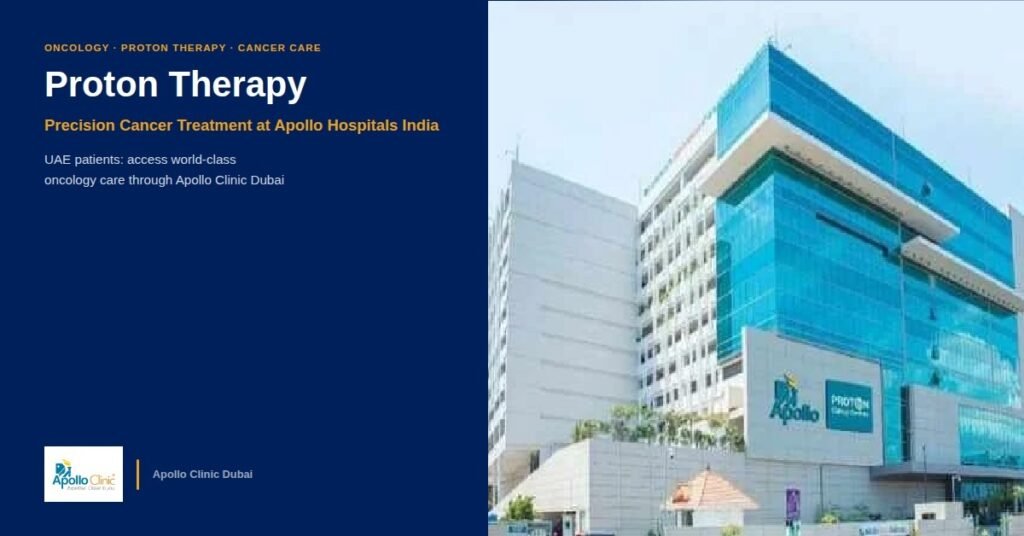
For patients facing a cancer diagnosis, understanding the treatment options available — and where the most advanced treatments can be accessed — is an important part of navigating the journey ahead. Proton therapy is one of the most precise forms of radiation treatment available today, and Apollo Hospitals India has established proton therapy capability as part of its advanced oncology programme. Apollo Clinic Dubai serves as a bridge for UAE patients who need access to this treatment, coordinating care between Dubai and India.
This article explains what proton therapy is, which cancer types it is used to treat, what patients can expect during and after treatment, and how UAE-based patients can access it through Apollo Clinic Dubai.
What Is Proton Therapy?
Proton therapy — also known as proton beam therapy — is a form of external beam radiation therapy that uses protons (positively charged particles) rather than the X-rays used in conventional radiotherapy. The key difference lies in how protons deposit their energy in tissue.
Conventional X-ray radiation delivers energy along its entire path through the body — entering, passing through the tumour, and exiting the other side. Protons, by contrast, travel through tissue with relatively little energy release until they reach a specific depth — determined by the energy of the beam — where they deposit the majority of their energy in what is called the Bragg Peak. This allows radiation oncologists to concentrate the therapeutic dose precisely at the tumour while substantially reducing the dose to healthy tissue beyond the target.
🎯 The clinical significance: Lower radiation dose to surrounding healthy tissue means a reduced risk of radiation-related side effects and long-term complications — particularly important for paediatric patients (where protecting developing tissue is critical), for tumours near sensitive structures such as the brain, spinal cord, or eyes, and for patients who may require re-irradiation of a previously treated area.
Cancer Types Where Proton Therapy Is Used
🧠 Brain and Central Nervous System Tumours
Proton therapy’s precision is particularly valuable in treating brain tumours, where minimising dose to surrounding neural structures is critical to preserving neurological function. It is used in both primary brain tumours and in tumours near the skull base — such as chordomas and chondrosarcomas — where surgical access is limited and conventional radiotherapy risks significant collateral exposure to the brain and brainstem.
👁️ Ocular Tumours
Uveal melanoma and other ocular tumours are among the earliest applications of proton therapy. The ability to precisely target the eye tumour while protecting the optic nerve and surrounding structures makes proton therapy a preferred modality for many eye tumour cases where vision preservation is a goal.
👶 Paediatric Cancers
Children’s developing tissues are particularly sensitive to radiation. Proton therapy’s ability to reduce dose to non-target areas is especially significant in paediatric oncology, where the long-term consequences of radiation exposure — including effects on growth, cognitive development, and secondary cancer risk — are major considerations in treatment planning. Paediatric brain tumours, medulloblastoma, rhabdomyosarcoma, and other paediatric solid tumours are commonly treated with proton therapy where it is available.
🫁 Lung Cancer
In lung cancer, proton therapy can reduce dose to the heart and contralateral lung compared to conventional radiotherapy — important in patients with compromised pulmonary function or cardiac history. It is used in both early-stage and locally advanced non-small cell lung cancer where precise tumour targeting with heart and lung sparing is a priority.
🩺 Prostate Cancer
Proton therapy is one of several definitive treatment options for localised prostate cancer. The proximity of the prostate to the bladder, rectum, and neurovascular structures makes dose precision relevant to preserving urinary and sexual function. Proton therapy is used for both standard and hypofractionated prostate radiotherapy protocols at specialist centres.
🗣️ Head and Neck Cancers
Head and neck cancers involve complex anatomy where critical structures — salivary glands, the spinal cord, the larynx, and swallowing muscles — are in close proximity to tumour targets. Reducing dose to these structures can meaningfully reduce the risk of xerostomia (dry mouth), dysphagia, and other treatment-related effects that significantly affect quality of life after head and neck radiotherapy.
🦴 Bone and Soft Tissue Tumours
Chordomas, chondrosarcomas, and selected soft tissue sarcomas — often in anatomically complex locations including the skull base, spine, and pelvis — are among the tumour types where proton therapy’s precision is most clinically significant, particularly where tumours are adjacent to the spinal cord or other critical structures.
What to Expect: The Proton Therapy Treatment Journey
Proton therapy begins with a detailed consultation with a radiation oncologist experienced in proton therapy. Detailed imaging — typically CT simulation, often combined with MRI — is used to precisely map the tumour and surrounding anatomy. A treatment plan is designed to define the beam angles, energy levels, and dose distribution. This planning phase can take several days to complete.
Proton therapy is delivered in a series of daily sessions (called fractions) over a period of weeks — the exact number depending on the tumour type, location, and treatment protocol. Each session is typically brief; the patient is positioned in a custom-fitted immobilisation device to ensure reproducibility of positioning, and the treatment itself lasts only minutes. Patients are awake and experience no immediate sensation from the beam.
Patients are reviewed regularly during the treatment course by the oncology team. Imaging may be repeated to confirm tumour response and verify ongoing accuracy of treatment delivery. Side effects, if any, are managed as they arise.
Side effects from proton therapy vary by treatment site but are generally similar in nature to those of conventional radiotherapy, often with reduced severity due to the lower dose to surrounding tissue. Fatigue is common during and after treatment. Site-specific effects — such as skin reaction, mucositis in head and neck treatment, or urinary symptoms in prostate treatment — are managed by the oncology support team. Follow-up imaging and clinical review after treatment completion monitors for tumour response and late effects.
Accessing Proton Therapy at Apollo Hospitals India Through Apollo Clinic Dubai
Apollo Hospitals India has established advanced radiation oncology capability including proton therapy as part of its comprehensive cancer care programme. For UAE-based patients — whether UAE nationals, expatriate residents, or visitors — Apollo Clinic Dubai offers a coordinated pathway to access specialised cancer treatment in India.
The Apollo Clinic Dubai team works with Apollo Hospitals India’s oncology specialists to:
- Provide initial consultation and clinical review in Dubai to assess suitability for specialist treatment in India
- Coordinate medical records, imaging, and specialist referral to the appropriate Apollo Hospitals centre
- Support visa and travel arrangements for patients and their accompanying family members
- Communicate with the treating team in India throughout the patient’s treatment course
- Provide follow-up care and monitoring after the patient returns to the UAE
Apollo Clinic Dubai — Your Gateway to Apollo Hospitals Cancer Care
If you or a family member is facing a cancer diagnosis and want to understand your treatment options — including proton therapy at Apollo Hospitals India — our team at Apollo Clinic Dubai is here to help. Contact us to arrange a consultation.
Frequently Asked Questions
Proton therapy is not the appropriate treatment for all cancer types. Its advantages are most significant where precise dose delivery and reduction of dose to adjacent structures materially affects outcomes or side effects. A radiation oncologist with proton therapy expertise will assess whether it is the preferred modality for a specific patient’s tumour type, stage, and anatomy.
Both proton therapy and IMRT are forms of precision radiation delivery. IMRT uses multiple X-ray beams shaped and modulated to concentrate dose at the tumour target. Proton therapy’s physical advantage — the Bragg Peak — means it can achieve comparable or better tumour dose coverage with a lower total body radiation dose, which is clinically significant for certain tumour types and patient populations. The appropriate choice depends on the specific clinical situation.
Treatment duration varies significantly by indication. Some proton therapy protocols are delivered in a relatively small number of fractions (stereotactic body radiotherapy approaches for certain tumours); others involve a standard fractionation course that may run five days a week for several weeks. A radiation oncologist will advise on the expected treatment duration after reviewing the individual case.
Yes — Apollo Clinic Dubai provides a coordinated referral and support service for patients seeking specialist treatment at Apollo Hospitals India, including oncology consultations and treatment. Contact our team to discuss your situation and arrange an initial consultation.
Proton therapy can cause side effects, which vary depending on the treatment site, dose, and individual patient factors. In general, the side effects are similar in nature to those of conventional radiotherapy but may be less severe due to the reduced dose to surrounding healthy tissue. The oncology team will discuss expected side effects specific to the treatment plan before therapy begins.
This article is for general educational purposes and does not constitute medical advice. Cancer treatment decisions are complex and should be made in consultation with qualified oncology specialists who have reviewed the individual patient’s case. Apollo Clinic Dubai facilitates referral to Apollo Hospitals India; treatment suitability is determined by the treating medical team.