What Does an Endodontist Do? Understanding Root Canal Specialists in the UAE
Tooth pain that keeps you awake at night, or a sensitivity that never quite goes away — these are often the first signs that something is wrong deep inside a tooth. When the problem involves the dental pulp or root canal system, a specialist called an endodontist is the right person to see. This guide explains what endodontists do, what to expect from root canal treatment, and when it may be time to make an appointment.
What is Endodontics?
Endodontics is the branch of dentistry concerned with the dental pulp — the soft tissue inside the tooth — and the tissues surrounding the roots of a tooth. The word comes from the Greek endo (inside) and odont (tooth). Endodontists specialise in diagnosing and treating diseases and injuries that affect this inner structure, most commonly through root canal treatment. Endodontics is recognised as a distinct dental specialty by leading bodies including the British Dental Association (BDA) and the American Association of Endodontists (AAE).
What Is an Endodontist?
An endodontist is a dental specialist who has completed additional postgraduate training — typically two or more years beyond a standard dental degree — focused entirely on the diagnosis, prevention, and treatment of conditions affecting the dental pulp and surrounding root structures.
While a general dentist is trained to carry out straightforward root canal treatments and will refer complex cases to a specialist, an endodontist’s training and daily practice centres on exactly this area of dentistry. They use advanced imaging techniques, specialist instruments, and magnification — often a dental operating microscope — to work with precision inside the very narrow spaces of the root canal system.
Specialist vs General Dentist
A general dentist is your first point of contact for most dental concerns, including routine fillings, cleanings, and initial assessments. An endodontist is a referral specialist brought in when the inner structures of the tooth are involved — particularly in cases where the anatomy is complex, where previous treatment has not resolved the problem, or where precise diagnosis is needed.
When Should You See an Endodontist?
Your general dentist may refer you to an endodontist, or you may seek specialist advice directly. The following symptoms are commonly associated with conditions that fall within an endodontist’s area of expertise. If you are experiencing any of these, it is worth seeking professional dental assessment promptly.
- Persistent or severe toothache — particularly pain that is deep, throbbing, or difficult to localise
- Prolonged sensitivity to heat or cold — sensitivity that lingers for more than a few seconds after the stimulus is removed
- Swelling or tenderness — in the gum around a tooth, or in the face or jaw
- A tooth that has darkened — discolouration of a single tooth can indicate changes to the dental pulp
- A persistent pimple on the gum — a small raised bump that may drain and return is often associated with infection at the root
- Pain when biting or applying pressure — discomfort that is triggered specifically by chewing or pressing on the tooth
- A tooth that has been traumatised — following an injury, even if the tooth appears intact and is not immediately painful
These symptoms do not always mean root canal treatment is necessary — an endodontist will assess each case individually. In some situations, the priority is preserving the tooth through treatment; in others, diagnosis alone confirms the issue can be managed another way.
What Is Root Canal Treatment?
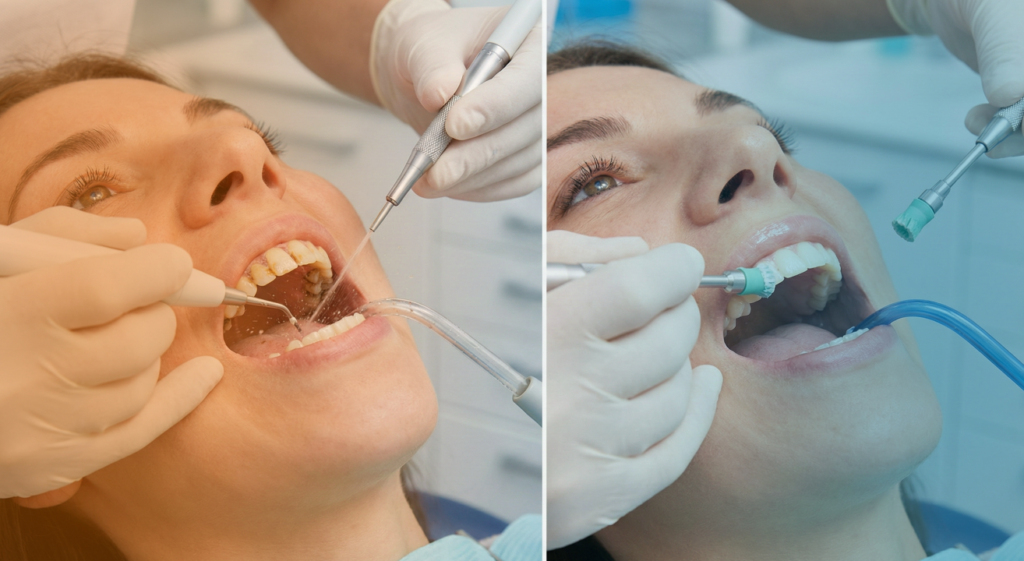
Root canal treatment — also called endodontic treatment — is a procedure to remove infected or damaged pulp from inside a tooth, clean and shape the root canals, and seal the tooth to prevent further infection. The goal is to relieve pain and save a tooth that would otherwise need to be extracted.
The procedure typically unfolds across one or two appointments, depending on the complexity of the case. Here is a general outline of the steps involved.
-
Diagnosis and imaging
The endodontist takes X-rays — and in some cases a cone beam CT scan — to understand the shape of the root canals and the extent of infection or damage. A thorough clinical examination is also carried out. -
Local anaesthesia
The area around the tooth is numbed with a local anaesthetic before any work begins. The procedure is carried out with the tooth fully anaesthetised, so you should not feel pain during treatment. -
Access and pulp removal
A small opening is made through the crown of the tooth to access the pulp chamber. The infected or inflamed pulp tissue is then carefully removed from the pulp chamber and root canals. -
Cleaning and shaping
The root canals are cleaned, shaped, and irrigated using fine instruments and antimicrobial solutions. This step removes bacteria and debris, and prepares the canal walls to receive the filling material. -
Filling the canals
The cleaned canals are filled and sealed with a biocompatible material — most commonly gutta-percha — to prevent bacteria from re-entering. The access opening is then temporarily or permanently sealed. -
Restoration
A tooth that has undergone root canal treatment usually needs a crown to protect it and restore full function. This is typically arranged with your general dentist following the endodontic procedure.
Is Root Canal Treatment Painful?
Root canal treatment has a longstanding reputation for being painful — a reputation that does not reflect modern dental practice. The discomfort people associate with root canal treatment is almost always the pain caused by the infection or inflammation before treatment, not the procedure itself.
Because the tooth and surrounding tissue are thoroughly anaesthetised before work begins, most patients report feeling pressure or movement during the procedure but not pain. Advances in local anaesthetic formulations and techniques mean that effective anaesthesia can be achieved even in teeth that are acutely inflamed, which was historically more challenging.
Some tenderness or mild sensitivity in the days following treatment is normal — the tissues around the root have been through a procedure — and this typically settles with over-the-counter pain relief as directed by your dentist. Your endodontist will advise you on what to expect and when to get in touch if symptoms do not improve.
After Root Canal Treatment — What to Expect
Recovery from root canal treatment is usually straightforward for most patients. Here is what is generally expected in the days and weeks that follow.
Immediately after the procedure
The anaesthetic will take a few hours to wear off. Avoid eating on the treated side while the tooth is numb. Mild soreness or sensitivity around the tooth is common for a few days and can generally be managed with over-the-counter pain relief.
Crown placement
A tooth that has had root canal treatment is often more brittle than a vital tooth. Placing a crown over it protects the tooth from fracture and restores its appearance and bite function. Your endodontist or general dentist will discuss the appropriate timing and type of restoration for your specific situation.
Follow-up
Your endodontist may schedule a follow-up appointment — typically at six to twelve months — to take an X-ray and confirm that the bone around the root is healing as expected. In most cases, a treated tooth can function normally for many years with proper oral care and regular dental check-ups.
Caring for a Treated Tooth
Good oral hygiene — brushing twice daily, flossing, and regular professional cleaning — applies to a restored tooth just as it does to every other tooth. The crown and the tooth root can still be affected by gum disease and decay if they are not cared for properly.
Signs You May Need to See an Endodontist
-
Persistent, severe, or throbbing toothache -
Sensitivity to heat or cold that lingers after the stimulus is removed -
Swelling of the gum, face, or jaw around a tooth -
Darkening or discolouration of a single tooth -
Pain when biting down or pressing on the tooth -
A recurring pimple or small bump on the gum near a tooth -
A tooth that has been knocked, chipped, or traumatised -
A previous root canal that may not have fully resolved
Frequently Asked Questions
Do I need a referral to see an endodontist in the UAE?
In many cases your general dentist will refer you to an endodontist when they identify a problem that requires specialist management. However, it is also possible to seek a specialist consultation directly. Apollo Clinic UAE welcomes both referrals and direct patient enquiries — if you are unsure, contact our team and we will help guide you through the right path for your situation.
How many appointments does root canal treatment usually take?
The number of appointments depends on the complexity of the case and the condition of the tooth. Straightforward cases are often completed in one or two visits. More complex situations — such as a tooth with a previous failed treatment, a very curved root system, or an active infection — may require additional appointments. Your endodontist will be able to give you a clearer picture after the initial examination and imaging.
Is it better to have a tooth extracted rather than have root canal treatment?
Keeping your natural tooth is generally the preferred outcome where it is clinically viable. A natural tooth that has been successfully treated and properly restored can continue to function well. Extracting a tooth introduces considerations of its own — including the need to replace it with an implant, bridge, or denture to maintain bite function and prevent neighbouring teeth from shifting. Your dentist and endodontist are the best people to help you weigh the options for your specific situation.
Sources & References
- American Association of Endodontists (AAE). What Is an Endodontist? aae.org
- American Association of Endodontists (AAE). Root Canal Treatment: Endodontic Treatment Explained. aae.org
- British Dental Association (BDA). Endodontics — Dental Specialties. bda.org
- European Society of Endodontology (ESE). Quality Guidelines for Endodontic Treatment. International Endodontic Journal. ese-endodontology.org
- NHS. Root Canal Treatment. nhs.uk
This article is written for general informational purposes only. It does not constitute dental or medical advice, diagnosis, or a treatment recommendation for any individual. The information provided reflects generally accepted knowledge about endodontics and root canal treatment and should not replace a professional consultation with a qualified dental practitioner. If you are experiencing dental symptoms, please consult a registered dentist or specialist. Apollo Clinic UAE cannot accept responsibility for reliance on the general information contained in this article.