
Can Proton Therapy Treat My Cancer? A Guide for UAE Patients Considering Treatment in India
Key Takeaways
Proton therapy is a highly precise, non-invasive form of radiation treatment that can benefit patients with certain cancerous and non-cancerous tumors, including some considered inoperable or unsuitable for conventional radiotherapy. Apollo Proton Cancer Centre (APCC) in Chennai is the only proton therapy facility in South Asia and the Middle East, and UAE-based patients can begin the evaluation process through Apollo Clinic UAE.
- Proton therapy deposits most of its radiation dose directly at the tumor, with minimal dose beyond it — a property known as the Bragg Peak.
- This precision can spare more surrounding healthy tissue compared with conventional photon-based radiotherapy.
- It is used for select brain, spinal, pediatric, prostate, head and neck, and other tumors, including some recurrent or hard-to-reach cases.
- Apollo Proton Cancer Centre, Chennai, is South Asia and the Middle East’s only proton therapy center and India’s first JCI-accredited cancer hospital.
- Not every cancer benefits from proton therapy — suitability is determined by a multidisciplinary oncology team after reviewing the individual case.
- UAE-based patients can start with a consultation and records review at Apollo Clinic UAE before travelling to Chennai for treatment.
Can Proton Therapy Treat My Cancer?
A cancer or tumor diagnosis brings many questions, and one of the first is often which treatment approach will be most effective with the fewest side effects. For some patients, proton therapy is worth discussing with their oncology team, including in cases where a tumor is considered difficult to reach surgically or difficult to treat safely with conventional radiation because of its location near sensitive organs.
Proton therapy is not a treatment for every cancer, and it is not always the first choice even when it is an option. Whether it is suitable depends on the type, size, and location of the tumor, and this is best assessed through consultation with a radiation oncologist familiar with the technology.
How Proton Therapy Differs From Conventional Radiation
Conventional radiotherapy uses X-ray photons, which deposit energy along their entire path through the body, including tissue beyond the tumor. Proton therapy instead uses positively charged particles called protons, which can be controlled to release most of their energy at a specific depth — the tumor itself — and then stop, depositing very little dose beyond that point. This effect is known as the Bragg Peak.
In practice, this allows radiation oncologists to shape a high dose tightly around the tumor while reducing exposure to nearby healthy organs and tissue. That distinction matters most in cases where organs at risk sit close to the tumor, such as tumors near the brainstem, spinal cord, or in children, where minimizing dose to developing tissue is a particular priority.
Proton Therapy vs Conventional Radiotherapy
| Factor | Conventional Radiotherapy (Photon) | Proton Therapy |
| How dose is delivered | Energy deposited along the full beam path, including tissue beyond the tumor | Most energy deposited precisely at the tumor depth (Bragg Peak), minimal dose beyond it |
| Effect on surrounding tissue | Some unavoidable dose to nearby healthy tissue and organs | Reduced dose to surrounding healthy tissue in suitable cases |
| Commonly considered for | A broad range of cancers and treatment settings | Tumors near critical organs, pediatric cancers, select recurrent or reirradiation cases |
| Availability | Widely available | Limited number of centres globally; APCC Chennai is the only one in South Asia and the Middle East |
Cancers and Conditions Where Proton Therapy May Be Considered
Proton therapy is used across a range of oncology programs. Based on published clinical use at proton centres, including APCC, it is most often considered for:
· Brain and skull-base tumors: Craniopharyngiomas, low-grade and high-grade gliomas, meningiomas, pituitary adenomas, and recurrent brain tumors
· Pediatric cancers: Medulloblastoma and other cases requiring craniospinal irradiation, where sparing developing tissue is a priority
· Prostate cancer: Particularly where sparing the bladder, rectum, and surrounding nerves is a treatment goal
· Head, neck, and skull-base cancers: Where proximity to critical structures such as the eyes, brainstem, or spinal cord makes precision especially important
· Reirradiation cases: Cases where a tumor has recurred in a previously irradiated area and further conventional radiation would risk excessive cumulative dose
This list is illustrative, not exhaustive. Whether proton therapy is appropriate for a specific diagnosis can only be determined by an oncology team after reviewing the full case, including imaging and pathology.
Proton Therapy at Apollo Proton Cancer Centre, Chennai
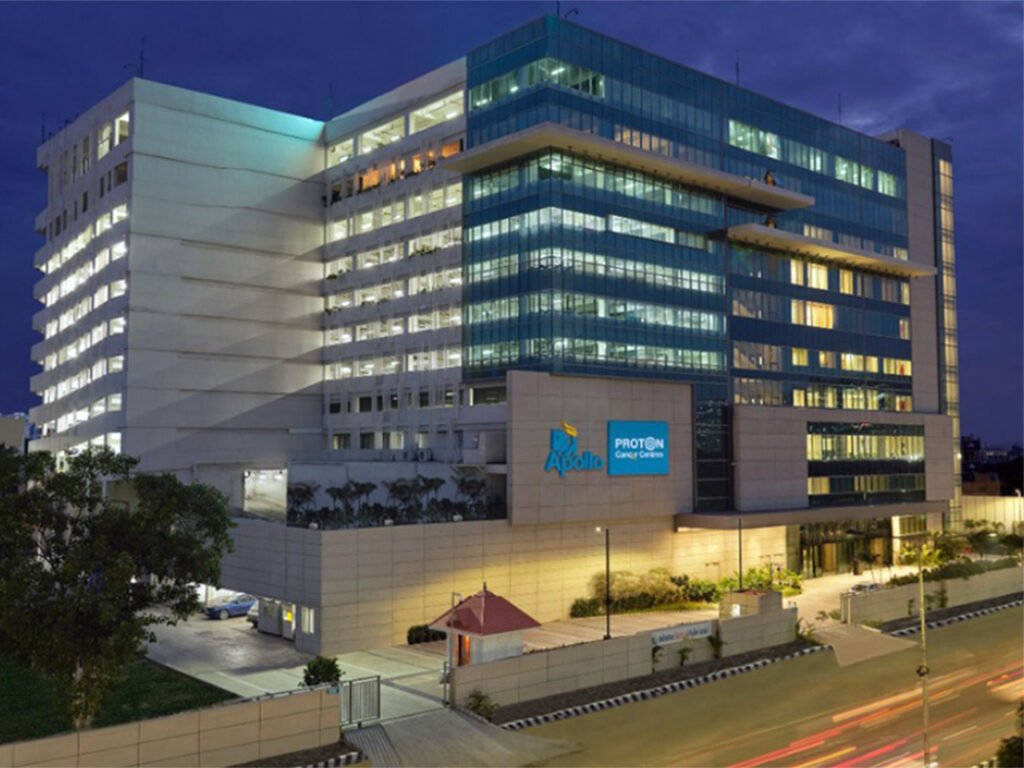
Apollo Proton Cancer Centre (APCC) in Tharamani, Chennai, is the first and only proton therapy centre in South Asia and the Middle East, and India’s first Joint Commission International (JCI) accredited cancer hospital. It is a 150-bed, fully integrated cancer centre bringing surgical oncology, medical oncology, and radiation oncology — including proton therapy — together under one roof, supported by a multidisciplinary cancer management team that reviews cases before treatment begins.
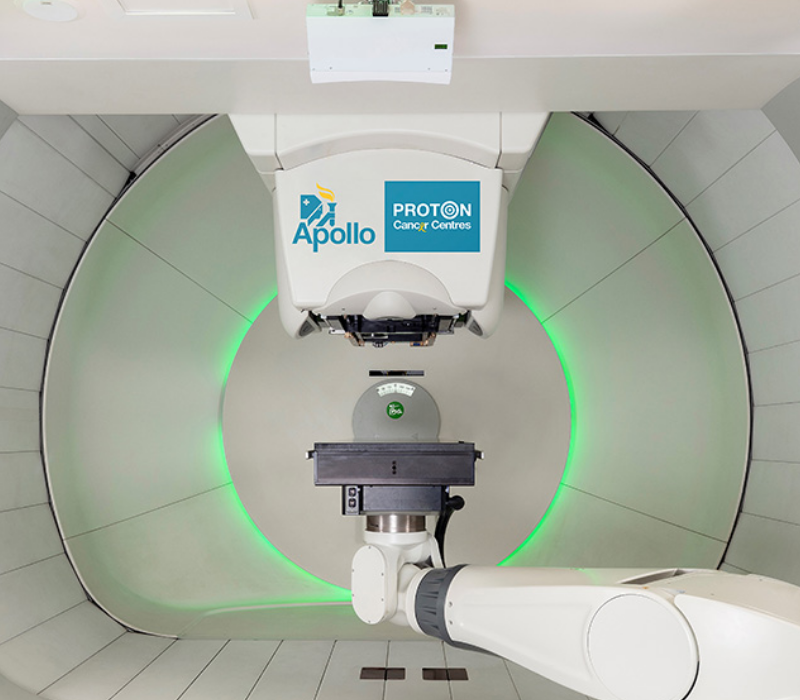
APCC delivers proton therapy using Pencil Beam Scanning and Intensity-Modulated Proton Therapy (IMPT), techniques that allow the proton beam to be shaped and modulated for the specific dimensions of each tumor. The centre has treated patients from across India, as well as from Southeast Asia, the Middle East, and Africa, since opening in 2019.
How UAE-Based Patients Can Access Proton Therapy via Apollo Clinic UAE
Because proton therapy is not yet available within the UAE, patients and families typically need to coordinate between a local point of contact and the treating centre abroad. Apollo Clinic UAE can support UAE-based patients considering proton therapy at Apollo Proton Cancer Centre, Chennai, through the following general pathway:
1. Initial consultation at Apollo Clinic UAE to discuss the diagnosis and share existing medical records, pathology, and imaging.
2. Case review by the multidisciplinary oncology team at APCC, Chennai, to assess whether proton therapy is a suitable option.
3. A treatment recommendation, expected number of sessions, and cost estimate shared with the patient before travel is arranged.
4. Coordination of travel logistics, appointment scheduling, and visa support for the visit to Chennai.
5. Treatment delivered at APCC, typically as a course of daily outpatient sessions over several weeks depending on the case.
6. Post-treatment imaging and follow-up, coordinated between the APCC team and Apollo Clinic UAE where possible.
Conclusion
Proton therapy offers a precise, non-invasive treatment option for select cancerous and non-cancerous tumors, particularly where sparing nearby healthy tissue is a clinical priority. It is not the right option for every diagnosis, and its value depends on the specific tumor being treated. For UAE-based patients exploring this option, Apollo Clinic UAE offers a starting point for evaluation, with treatment available at Apollo Proton Cancer Centre, Chennai — the only facility of its kind in South Asia and the Middle East. The most important next step for anyone considering proton therapy is a consultation with an oncology team to review the specific case.
Frequently Asked Questions
What makes proton therapy different from standard radiotherapy?
Proton therapy uses charged particles that release most of their energy directly at the tumor and very little beyond it, a property called the Bragg Peak. Conventional radiotherapy uses X-rays, which deposit energy along their full path through the body, including some tissue beyond the tumor.
Is proton therapy suitable for all types of cancer?
No. Proton therapy is most often considered for tumors near critical organs, certain pediatric cancers, some recurrent tumors, and select cases such as prostate or skull-base cancers. Suitability is assessed individually by an oncology team based on tumor type, size, and location.
Where is the nearest proton therapy centre for UAE patients?
Apollo Proton Cancer Centre in Chennai, India, is the closest proton therapy facility to the UAE and the only one in South Asia and the Middle East. UAE-based patients can begin the evaluation process through Apollo Clinic UAE.
How many proton therapy sessions are usually needed?
The number of sessions depends on the tumor type, size, and treatment goal. Courses can range from a small number of sessions to several weeks of daily outpatient treatment, similar in schedule to conventional radiotherapy but often with a different overall plan.
Does proton therapy involve surgery or hospital admission?
No. Proton therapy is a non-invasive, outpatient procedure. Most patients are able to continue daily activities during their course of treatment, though this can vary depending on the individual case.
How can a UAE-based patient start the process of accessing proton therapy in India?
The process typically begins with a consultation at Apollo Clinic UAE, where existing medical records and imaging are reviewed and shared with the oncology team at Apollo Proton Cancer Centre, Chennai, for a suitability assessment before any travel is arranged.
Medical Disclaimer
This article is intended for general information only and does not replace professional medical advice, diagnosis, or treatment. Suitability for proton therapy varies by individual case and can only be determined by a qualified oncology team after reviewing full medical records, imaging, and pathology. Please consult a doctor to discuss options specific to your diagnosis.