
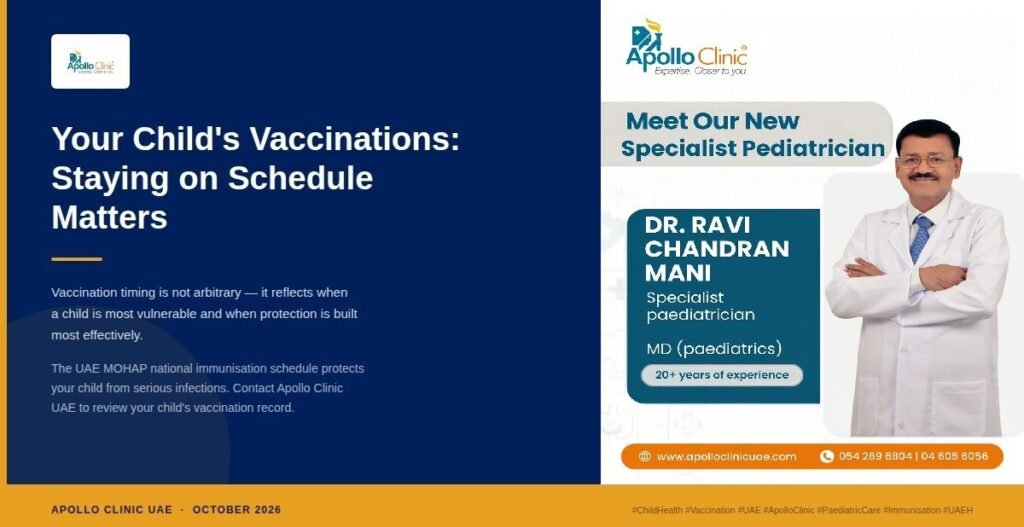
Childhood Vaccination in the UAE: A Parent’s Guide to the Immunisation Schedule
Vaccination is one of the most reliable preventive health tools available. For parents in the UAE, understanding what vaccines are recommended for children, when they are given, and why the schedule is structured the way it is can help make vaccination appointments less stressful and more meaningful.
This article provides general educational information about childhood immunisation. The UAE Ministry of Health and Prevention (MOHAP) publishes the official national immunisation schedule, which is the authoritative guide for children in the UAE. Parents should always consult their child’s paediatrician or family physician for guidance specific to their child.
Why Vaccination Schedules Are Timed the Way They Are
A common question parents have is: why does a newborn need certain vaccines so early? The timing of vaccines is not arbitrary — it reflects the window in which a child is most vulnerable to specific diseases and the age at which the immune system is best able to develop a protective response to each vaccine type.
Vaccines given in series (two or three doses of the same vaccine over several months) work because the immune system’s response builds with each dose. The first dose introduces the immune system to the vaccine antigen; subsequent doses strengthen and extend that response. Missing or delaying doses can leave gaps in protection during the period when a child is most at risk.
Key Vaccines on the UAE National Immunisation Schedule
🟡 Hepatitis B
The hepatitis B vaccine is given in a series beginning at birth. Hepatitis B is a viral infection that can cause liver disease, and newborns are particularly vulnerable to chronic infection if exposed. Beginning vaccination at birth provides protection during the most critical window.
🟢 BCG (Bacillus Calmette-Guérin)
The BCG vaccine, given at birth, provides protection against severe forms of tuberculosis in young children. It remains part of the UAE’s national schedule given the country’s diverse expatriate population and travel patterns.
🔵 DTP (Diphtheria, Tetanus, Pertussis)
This combination vaccine is given in a primary series in the first year of life and followed by booster doses. Whooping cough (pertussis) is particularly dangerous for very young infants. Timely vaccination — including of parents and caregivers — is important for protecting newborns who are too young to be fully vaccinated themselves.
🟠 Polio (IPV)
Inactivated polio vaccine is given as part of the primary series. While polio has been eradicated in many regions, continued vaccination maintains the protection that has made eradication possible and guards against reintroduction.
🟣 Haemophilus influenzae type b (Hib)
Hib is a bacterial infection that can cause serious conditions including meningitis and pneumonia in young children. Vaccination against Hib has dramatically reduced the incidence of these conditions in countries with high vaccination coverage.
🔴 Pneumococcal Conjugate Vaccine (PCV)
Protects against infections caused by Streptococcus pneumoniae, a common cause of bacterial meningitis, pneumonia, and ear infections in children. Given in a series in infancy.
🟤 MMR (Measles, Mumps, Rubella)
The MMR vaccine is given in two doses, typically starting around 12 months. Measles in particular can cause serious complications including pneumonia and encephalitis, and outbreaks continue to occur in communities with incomplete vaccination coverage.
🟡 Varicella (Chickenpox)
The varicella vaccine is included in the UAE schedule. While chickenpox is often considered a mild childhood illness, it can cause serious complications, particularly in immunocompromised children and adults who contract it later in life.
📋 For parents: The UAE MOHAP national immunisation schedule is the official reference for vaccines given to children in the UAE. Your paediatrician will track your child’s vaccination history and advise on any catch-up doses needed if a dose was missed or delayed.
Common Parent Questions About Vaccination
A mild fever and some localised soreness at the injection site are common, short-lived reactions to some vaccines. They are signs that the immune system is responding. Serious allergic reactions to vaccines are rare. If you are concerned about a reaction, contact your paediatrician. Seek immediate care if your child has difficulty breathing, severe swelling, or a very high fever.
A mild illness (a cold or low-grade fever) is generally not a reason to delay vaccination. Your paediatrician will assess whether it is appropriate to proceed or to reschedule. High fever or significant illness may mean postponing by a few days. Always call ahead to discuss if you are unsure.
Bring your child’s existing vaccination records (in any language, if possible) to your first paediatric appointment in the UAE. Your paediatrician will compare your child’s vaccination history against the UAE schedule and advise on any catch-up doses needed. Most vaccines can be given on an accelerated schedule when needed.
The UAE has vaccination requirements linked to school entry. Ensuring your child’s vaccinations are up to date before school enrolment avoids administrative complications. Your clinic can provide a vaccination certificate if required.
Apollo Clinic UAE — Paediatric Care for Your Family
Apollo Clinic UAE’s paediatric team is here to guide your child’s vaccination schedule, address your questions, and support your family’s health from the earliest stages. Contact us to book a paediatric consultation or vaccination appointment.
Frequently Asked Questions
Your clinic or paediatrician maintains a vaccination record for your child. The UAE’s health systems also support electronic health records. If you need a printed certificate for school or travel purposes, ask your clinic. Government facilities can also provide records of vaccinations given through the public health system.
Yes. Booster doses of some vaccines are given in the school-age years. Additional vaccines, such as HPV vaccine (protecting against human papillomavirus, a cause of cervical and other cancers), are given to older children. Your paediatrician or family doctor will advise on these at appropriate ages.
Apollo Clinic UAE provides travel health consultations and travel vaccinations. If your family is planning international travel, a pre-travel consultation at least 4–6 weeks before departure allows time for vaccinations that require multiple doses or build-up time.
Live attenuated vaccines contain a weakened form of the pathogen (e.g., MMR, varicella). Inactivated vaccines contain killed or inactivated pathogens or parts of them (e.g., IPV, hepatitis B). Both types are safe and effective, and neither type can cause the disease they protect against in healthy children. Your paediatrician can explain more if you have specific questions.

