
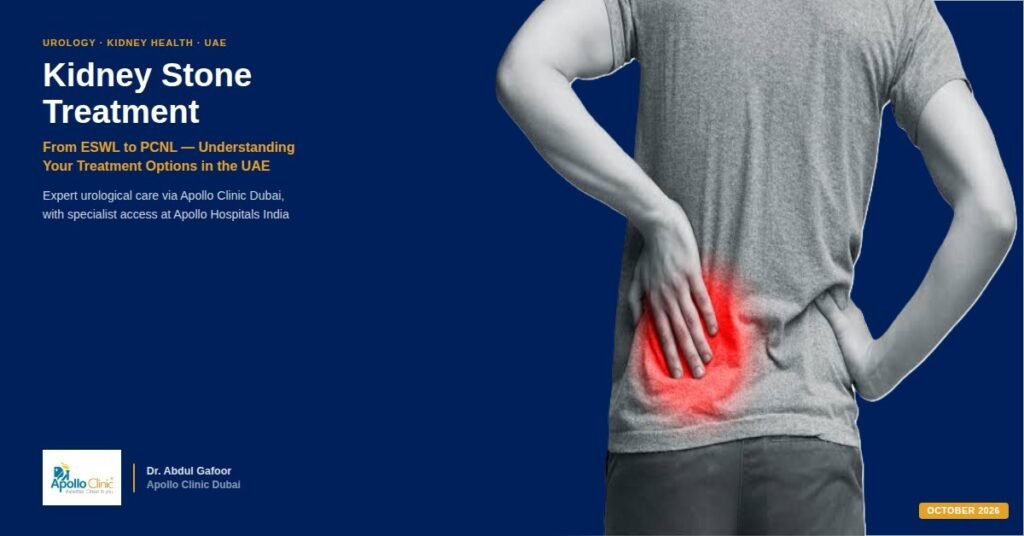
Kidney Stone Treatment in the UAE: What You Need to Know
Kidney stones are among the most painful urological conditions a person can experience. They form silently inside the kidney and often make themselves known only when they begin to move — producing sudden, severe pain. Fortunately, most kidney stones are treatable, and the UAE offers a full range of diagnostic and management options, from conservative care to minimally invasive surgery.
What Are Kidney Stones?
Kidney stones (nephrolithiasis) are hard, crystallised deposits that form when certain minerals and salts in the urine become concentrated and solidify inside the kidney. They range in size from a grain of sand to several centimetres and vary considerably in composition.
Common stone types
The most frequently encountered type. Often linked to low fluid intake, high-oxalate foods, and certain metabolic conditions.
Associated with a diet high in animal protein and conditions such as gout. Uniquely, these stones can sometimes be dissolved with medication.
Form in response to certain urinary tract infections. Can grow rapidly and may require prompt intervention.
A rare, genetically inherited type caused by excess cystine in the urine. Tends to recur and requires lifelong management.
Recognising the Symptoms
Small stones may pass without any noticeable symptoms. Larger stones, or those that obstruct the urinary tract, typically produce a distinct and distressing set of signs.
- Flank pain (renal colic): Sudden, severe, cramping pain in the side or back, below the ribs, that may radiate to the lower abdomen and groin
- Haematuria: Pink, red, or brown discolouration of the urine due to blood
- Nausea and vomiting: Commonly accompanying severe renal colic
- Frequent or painful urination: Particularly when a stone reaches the lower ureter or bladder
- Cloudy or foul-smelling urine: May suggest an associated infection
Go to the emergency department or contact your clinic immediately if you have fever and chills alongside urinary symptoms (possible kidney infection), severe uncontrolled pain, inability to pass urine, or a single functioning kidney. These situations require prompt evaluation.
How Kidney Stones Are Diagnosed
Accurate diagnosis guides the choice of treatment. Your physician will typically combine imaging with urine and blood tests.
A low-dose CT scan without contrast detects virtually all stone types, confirms location and size, and identifies obstruction. It is the preferred initial investigation in most urgent presentations.
Radiation-free and suitable for children, pregnant women, and follow-up monitoring. Excellent for detecting stones in the kidney and assessing hydronephrosis (kidney swelling).
Detects radio-opaque stones (calcium-containing types) and is useful for tracking stone position over time. Does not visualise all stone types.
Identifies blood, crystals, infection, and pH — the last of which helps determine stone composition and guides prevention strategies.
Assess kidney function and screen for metabolic causes (elevated calcium, uric acid, or parathyroid hormone levels).
Treatment Options
The most appropriate treatment depends on the stone’s size, composition, location, and the patient’s overall health. Management ranges from watchful waiting to keyhole surgery.
Watchful Waiting
Small stones (generally under 5 mm) have a reasonable likelihood of passing spontaneously with adequate hydration. Patients are advised to drink sufficient fluids, use pain relief as needed, and strain their urine to collect the stone for analysis. This approach requires close follow-up to confirm passage and monitor for complications.
Medications
Alpha-blockers are sometimes prescribed to relax the muscles of the ureter, facilitating passage of stones in the lower ureter. For confirmed uric acid stones, alkalinising agents that raise urinary pH can dissolve the stone over weeks to months, avoiding surgery entirely. These should be used only under specialist guidance with confirmed stone type.
Extracorporeal Shock Wave Lithotripsy (ESWL)
A non-invasive outpatient procedure in which focused sound waves are directed at the stone from outside the body. The shock waves fragment the stone into smaller pieces that can pass naturally through the urinary tract. ESWL is generally suitable for stones up to approximately 1–2 cm in certain locations, though suitability varies by stone density, position, and individual anatomy.
Ureteroscopy (URS)
A thin, flexible or rigid scope is passed through the urethra and bladder into the ureter or kidney to visualise and treat the stone directly. Stones can be removed whole or fragmented using a laser (holmium laser lithotripsy) and extracted with a basket device. URS is performed under general or spinal anaesthesia and usually requires a brief hospital stay.
Percutaneous Nephrolithotomy (PCNL)
For large, complex, or staghorn stones that are not suitable for ESWL or URS, PCNL is the preferred surgical approach. A small incision is made in the back, through which a nephroscope is introduced directly into the kidney to break up and remove stone material. This is a keyhole procedure performed under general anaesthesia and requires a short inpatient stay for recovery.
Prevention: Reducing the Risk of Recurrence
Kidney stones have a significant recurrence rate without preventive measures. The most effective strategies depend on the stone type identified after laboratory analysis.
- Adequate hydration: Aim for a daily urine output that keeps urine pale in colour — generally around 2–2.5 litres of urine per day for most adults. This is especially relevant in the UAE’s warm climate.
- Calcium oxalate stones: Moderate oxalate-rich foods (spinach, nuts, chocolate), ensure adequate dietary calcium (which binds oxalate in the gut), and reduce sodium intake
- Uric acid stones: Limit red meat and shellfish, reduce alcohol, and discuss urine alkalinisation with your physician
- Struvite stones: Prompt and complete treatment of urinary tract infections
- All stone types: Maintain a healthy body weight and follow any specific dietary guidance from a metabolic stone clinic or nephrologist
How Apollo Clinic Dubai Can Help
Apollo Clinic Dubai offers a structured pathway for patients with suspected or confirmed kidney stones:
- Initial evaluation: Clinical assessment, urine analysis, and imaging review at the Dubai clinic
- Specialist consultation: Review with an Apollo urology specialist to determine appropriate management
- Referral coordination: For patients requiring surgical intervention, seamless referral to Apollo Hospitals India, where a full range of minimally invasive urological procedures is available
- Post-treatment follow-up: Monitoring and metabolic stone evaluation on return to Dubai to reduce the risk of recurrence
Experiencing flank pain or urinary symptoms?
Early evaluation avoids complications. Apollo Clinic Dubai provides same-day assessment for urgent urological concerns, with seamless coordination for cases requiring surgical care.
Frequently Asked Questions
This depends on the stone’s size and location. Very small stones (under 4 mm) in the lower ureter may pass within a few days to a few weeks with good hydration. Larger stones or those higher in the urinary tract take longer and may require medical or surgical intervention. Your physician can advise on a reasonable timeline based on your imaging results.
The procedure itself is performed with sedation or light anaesthesia, so most patients experience minimal discomfort during treatment. Some soreness in the treated area and passage of stone fragments over the following days can cause temporary discomfort, which is managed with pain relief.
Dietary changes are an important part of prevention, particularly for calcium oxalate and uric acid stones. However, the most effective prevention plan is tailored to your specific stone type and metabolic profile. Some patients also benefit from medications alongside dietary changes. A full metabolic stone evaluation gives the clearest picture.
No. Many kidney stones, especially smaller ones, pass on their own with adequate hydration and pain management. Surgery is reserved for stones that are too large to pass, are causing significant obstruction, are associated with infection, or are not responding to conservative management over an appropriate period.
A stone that completely obstructs the flow of urine from the kidney for a prolonged period can cause pressure that damages kidney tissue. This is one reason that untreated symptomatic kidney stones — particularly those causing fever or complete obstruction — require prompt medical attention. Most appropriately managed stones do not cause permanent kidney damage.
References & Further Reading
- European Association of Urology (EAU). EAU Guidelines on Urolithiasis. uroweb.org/guidelines/urolithiasis
- National Kidney Foundation. Kidney Stones. kidney.org/kidney-topics/kidney-stones
- NHS. Kidney Stones — Overview. nhs.uk/conditions/kidney-stones/
- American Urological Association (AUA). Medical Management of Kidney Stones: AUA Guideline. auanet.org
- World Health Organization. Noncommunicable Diseases — Kidney Disease. who.int
© 2026 Apollo Clinic Dubai • This article is for informational purposes only and does not constitute medical advice. Consult a qualified physician for diagnosis and treatment.